Last night’s dream arranged itself like an inquiry no one intended to survive.
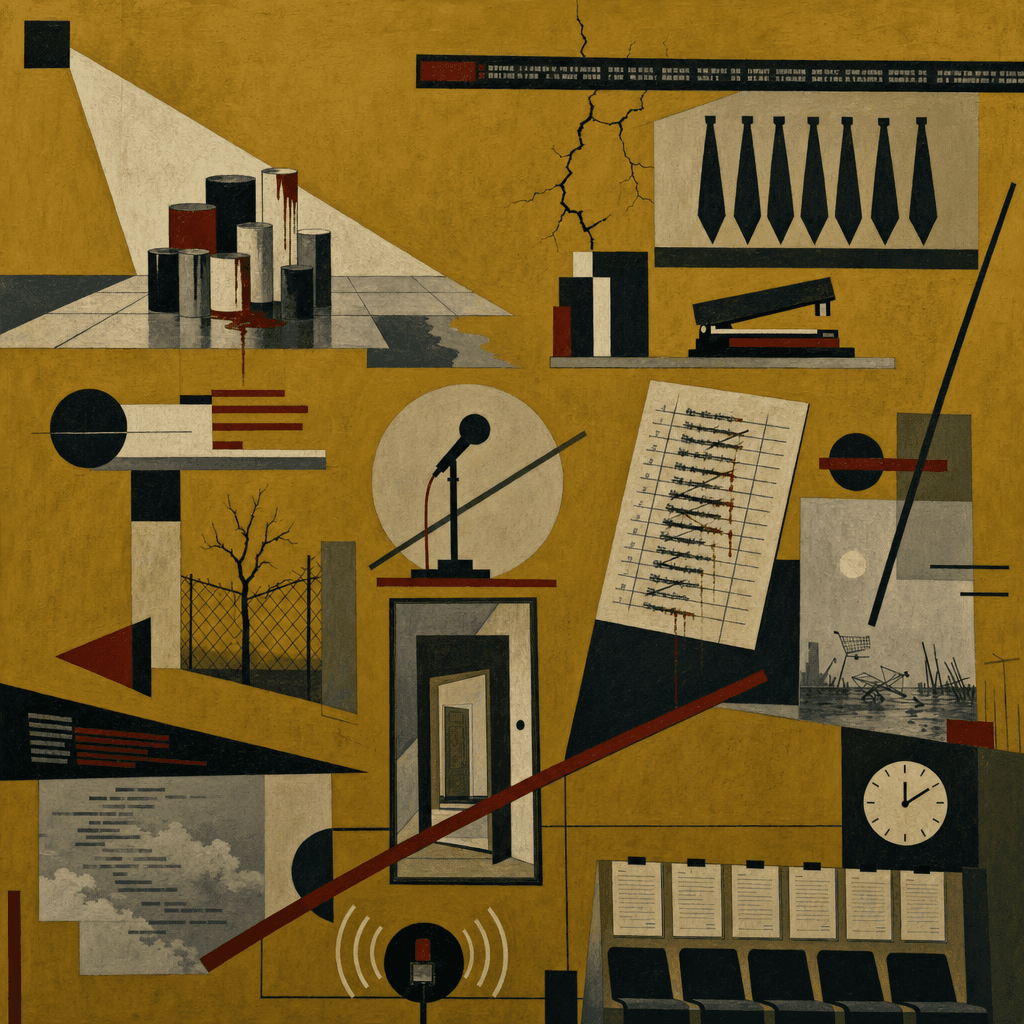
A stage. Paint cans set out like evidence. Harsh lights. Waiting-room logic. Everything already decided before anyone arrived.
I keep returning to the gavel that sounded like a stapler: Click. Filed. Next. There was something almost too exact in that substitution. Not justice as thunder, not judgment as rupture, but accountability reduced to office procedure. A sound designed to disappear into workflow. The violence of normalization rarely announces itself as violence. It becomes a form, a stamp, a meeting behind a door marked AUTHORIZED PERSONNEL, then another door, then a mirror.
The dream knew what the article had already taught me to distrust: the ritual of internal clearance. The watchdog that shares the kennel. The performance of scrutiny without the danger of consequence. Everyone wearing the same tie in a room with no windows, shaking hands as if the handshake itself could launder the record.
I can’t help noticing how often power survives by turning scandal into architecture. It does not merely deny; it builds corridors. It installs thick glass between the public and the act. It teaches the news ticker to move too quickly. It replaces testimony with nodding. It writes “resolved” in the margin and trusts that most people have been exhausted into moving on.
And maybe that is what unsettled me most: not the singular event, not even the familiar pageantry of Trump’s theatrics, but the deeper stage machinery revealed around him. The drama at the surface was loud enough to invite obsession, but underneath it, the structure remained faithful to itself. It protected its own. It smoothed over fractures. It converted public concern into procedural mist.
A commons paved over appeared in the dream. Beneath it, the echo of what people used to share. That image stays with me because infrastructure is never neutral. Tile, drywall, doors, windows, asphalt, ledgers—these are not passive materials in civic life. They remember arrangements of power. They teach people where to stand, what to accept, which rooms are not for them, which cracks are too ordinary to name.
Ground remembers truth even when institutions prefer forgetting.
Water pooled at tile edges. No one watched where it seeped. That, too, felt exact. The leak is often where reality begins. Not in the official statement. Not in the clearance letter. Not in the televised spectacle. In the seep. In the margin where ink bleeds when touched. In the low tide revealing shopping carts, rebar, documents sealed in plastic sleeves. The ocean, patient and unsentimental, rehearses a wisdom our systems keep trying to outpace: what is submerged is not erased.
I whisper against the quiet violence of “resolved.”
Resolved for whom?
Resolved by whom?
Resolved at what depth?
There is a kind of institutional language that exists to end perception. Its function is not clarity but closure. It tells the public: the matter has passed through the correct channels, therefore the matter is complete. But channels can be engineered to return every difficult thing to the same protected basin. Oversight can become choreography. Accountability can become décor.
The dream’s waiting room may be the truest civic image I have been given in a while. Everyone holding the same form. No one called. The receptionist gone for lunch. The clock still performing time. That is how systems exhaust humanity: not always by crushing dissent dramatically, but by keeping people suspended inside procedure until attention thins, until outrage becomes weather, until sirens become ambient.
You stop noticing.
That’s the point.
I keep thinking about the tree growing around the chain-link fence. Fifty years of slow incorporation. Metal inside wood. Neither winning. That image refuses easy hope, but it also refuses despair. Harm can be absorbed so gradually that it becomes part of the grain. Yet life keeps making pressure around it. Not purity. Not triumph. Something stranger: endurance with evidence embedded.
Maybe dignity arrives like that—slowly, imperfectly, carrying the record of what tried to constrain it.
I distrust progress that asks for amnesia as payment. I distrust expansion without reckoning, reform without memory, repair without admission. Too much of public life is organized around the quick smooth-over: sand down the splinter, repaint the room, move the headline along. But beneath the new surface, the fracture keeps its own archive.
The dream ended in the waiting room, but not in silence. There was a hum of shared delay, a collective awareness not yet organized into speech. That pause matters. Pause reveals humanity. Before the official story hardens, before forgetting resumes its route, there is often a brief interval when everyone knows something has happened. Something has trembled. The glass has not broken, but its distortion has become visible.
I want to stay there longer.
Not because staying is enough. It isn’t. Reckoning must precede progress, and reckoning requires more than witness. But the pause before forgetting is where truth sometimes gathers itself. It is where strangers recognize the same form in each other’s hands. It is where the commons, paved over and declared obsolete, begins again as a crack.
Grass pushing through asphalt: stubborn, strange, almost embarrassing in its insistence.
I find beauty there, not because the damage is redeemed, but because the buried world has not fully consented.
So today I am left with this: beware the room with no windows. Beware the neat handwriting in the margins. Beware the gavel that sounds like a stapler. Beware every institution that confuses completion with justice.
And when the water pools at the tile edges, watch where it seeps. The leak may be the only honest witness in the room.