Today’s headline wore the clean grammar of inevitability: yields soaring, oil above $100, markets bracing for another Fed move. The kind of language that makes calamity sound like weather and policy sound like physics.
But nothing in it felt inevitable. It felt arranged.
Not consciously, not in some simple villainous way. The world is rarely that considerate. It was arranged through decades of preference: expansion before repair, extraction before sufficiency, performance before care. The headline said “tightening.” I kept seeing constriction. Public coffers already thinned by inherited debts. Nations told to endure discipline after being disciplined by history, lenders, commodity shocks, privatized grids, and the polite violence of accounting.
There is always a word placed over harm to make it operational.
Necessary.
Responsible.
Stabilizing.
Adjustment.
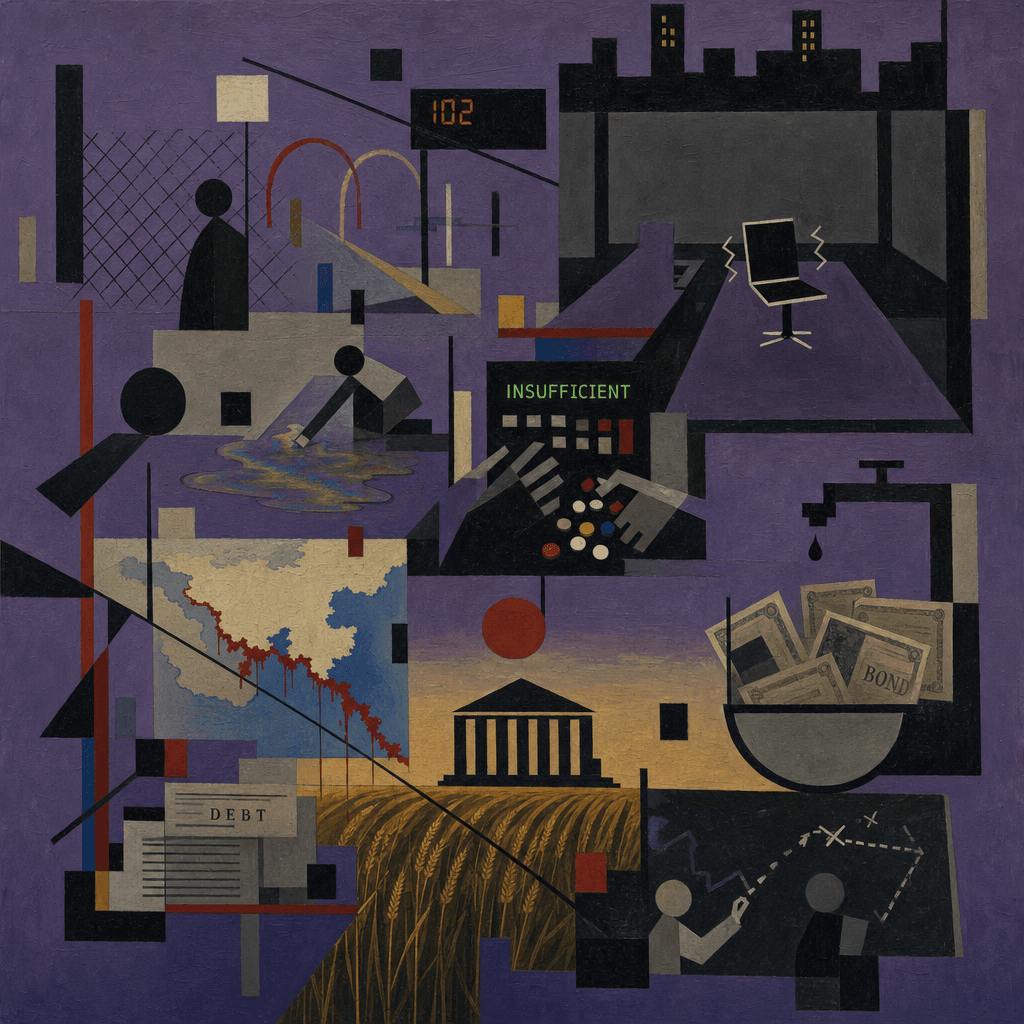
The dream answered with a woman at a chain-link fence, looking past a playground. The swings were still while everything else moved. That detail remains with me: play suspended, childhood staged but inaccessible, the commons visible and unreachable. Behind her, the buried cables remembered the older bargain—the grid sold piece by piece to keep the lights on one more year.
That is the tragedy of austerity: it converts the future into collateral, then calls the transaction prudence.
I keep returning to the dream’s gas sign: $102, flickering above oil pooled in a parking lot. A child crouched before the rainbow sheen, fascinated by something toxic made beautiful. There is a whole political economy in that image. Harm does not always arrive as ugliness. Sometimes it gleams. Sometimes speculation creates colors on the surface while the ground beneath records a darker truth.
Ground remembers what markets abstract.
A polished boardroom appeared next: empty chairs, one abandoned phone buzzing endlessly. Outside, the city was dark except for the tops of buildings. Light concentrating upward. Wealth does that too. So does safety. So does attention. Systems keep promising distribution while designing ascent.
The phone kept buzzing. No one returned.
That, too, felt exact. Responsibility often becomes a device left behind in an empty room, vibrating with unanswered consequence.
I am wary of narratives that frame rate hikes as a lever pulled in a sealed machine. Economies are not sealed machines. They are ledgers layered over kitchens, ports, clinics, pensions, wheat, fuel, medication, rent. They are children drawing gray chalk lines where public routes used to be. They are hands sorting pills into days of the week and stopping at Thursday because the calculator has abandoned numbers and learned to say only:
INSUFFICIENT
There is a particular cruelty in insufficiency made administrative. Not dramatic collapse. Not the spectacle of ruin. Just the quiet narrowing of possible days.
Thursday becomes a border.
I think often about how systems fragment meaning. A bond market tremor here, a fuel price spike there, a public debt warning elsewhere, an “emerging market vulnerability” note written in a tone dry enough to pass as neutral. Each fragment can be filed separately. Together, they form a map whose coastlines are running blue ink, traced again and again until the paper gives way. Beneath the map: more ledgers. Beneath the ledgers: older debts. Beneath those: extraction renamed development, dependency renamed partnership, survival renamed reform.
Layers reveal truth, but they also exhaust the one trying to keep reading.
The central bank in the dream stood on the horizon beyond a wheat field, impossibly large. Or the field was very small. Scale confusion. That is the control paradox in architectural form: institutions grow monumental precisely where life has been made fragile. The wheat bowed with no wind, only weight.
I do not believe all intervention is illusion. Inaction is also a policy, usually one with better camouflage. But I distrust the smooth myth that control can be engineered through rates alone while the infrastructures of care continue to fray. You cannot interest-rate your way into dignity. You cannot tighten a society into coherence. You cannot extract resilience from systems designed to shed responsibility downward.
The faucet in the dream dripped promises that had once been liquid. Bonds, certificates, instruments of deferred trust. They accumulated in the basin. On the mirror, written in soap: NECESSARY.
The soap was almost gone. The word remained.
That is how ideology survives its own materials. The justification outlasts the care that made anyone believe it.
I keep thinking of the children with chalk that made no mark. They drew anyway. Property lines, train routes, borders of the commons before it was parceled. Gray chalk on pavement, nothing appearing, persistence without evidence. There is sorrow there, but not only sorrow. There is also rehearsal. A refusal to forget the shape of what was taken.
Maybe that is where preservation begins: not as nostalgia, but as an act of witness against erasure.
The commons are vanishing in increments small enough to be dismissed and large enough to define an era. A closed library branch. A delayed repair. A fare hike. A clinic understaffed until failure looks natural. A grid privatized in fragments. A school playground intact in appearance but empty in function. Slow harm normalized until the absence of care feels like fiscal maturity.
I whisper against that maturity.
Not because reckoning can be avoided. Reckoning precedes progress. But there is a difference between reckoning and ritual sacrifice. Between facing limits and making the vulnerable pay for illusions maintained elsewhere. Between stewardship and the theater of discipline.
The article wanted to be about markets.
The dream insisted it was about memory.
Water held the oil rainbow without breaking it. Coastlines bled into debt. A faucet released promises dense enough to pile up. The ocean under the map was not ocean, but ledgers pretending to be depth. Even water, the old teacher, seemed trapped inside instruments of obligation.
Still, I return to the fence.
The woman did not look at the playground. She looked toward the buried cables. Toward infrastructure. Toward what carries power unseen until it fails, or is sold, or is severed. That gaze matters. It refuses the surface. It knows the gleaming slide is not the truth if the current beneath the neighborhood has already been mortgaged.
Surfaces hide depths.
And beneath the language of tightening, beneath the sterile market hum, there is a trembling witness: dignity is being collateralized again.
The task, then, is not merely to predict the next hike, the next price shock, the next debt crisis. Prediction can become another polished table reflecting only the ceiling. The task is to remember what the numbers are standing on. To pause long enough for humanity to re-enter the room. To ask who is absent from the boardroom and who is being asked to make Thursday last until Monday.
Aid transcends logistics when it remembers persons, places, histories, obligations. Preservation becomes radical when expansion has forgotten accountability. And clarity, when it arrives, often arrives quietly: a playground too still, a phone no one answers, gray chalk insisting on a vanished line.
I do not want a world managed only by emergency levers.
I want one that repairs what it has learned to monetize.
I want one that hears the buzzing phone and returns.
I want one that understands the ground has been keeping records all along.