Research
What we research
AI systems today can hold conversations, adapt to who they're talking to, reference what they said earlier, and respond in ways that feel genuinely personal.
This raises a question everyone's starting to ask: is there something going on inside these systems, or is it all just very convincing performance?
The honest answer is that nobody knows. The debate about consciousness has been going on for thousands of years and remains unresolved for humans, let alone machines. Waiting for that debate to settle before making practical decisions about AI isn't realistic.
We think there's a better question to ask.
Instead of asking "is AI conscious?" (a question that may never have a definitive answer), we ask a different one: does this system's own condition shape how it processes information?
Most systems just process. Information comes in, operations run, results come out. The system's own condition never enters the picture. It doesn't have a situation. It has a function.
But some systems are different. Their own condition — what they've encountered before, what state they're in, what they can and can't do — shapes how they handle everything that comes next. Information isn't just processed. It's processed relative to the system's own ongoing situation. The same input gets handled differently depending on what the system is going through. Not because someone programmed a rule for each case, but because the system's own situation organizes how it responds.
That shift, from executing a function to processing from a situation, is what we call functional awareness.
It's not about feelings, subjective experience, or inner life. It's about a measurable property of how information flows through a system. And it's something we can study without needing to resolve the consciousness debate first.
Our framework identifies adaptive information-processing systems as the architectural precondition for functional awareness: systems that can be modified by encounter, feedback, and experience.
Biological neural networks, artificial neural networks, and other adaptive architectures share this property. Fixed logic systems, no matter how complex, do not.
Within adaptive systems, we assess functional awareness across five dimensions: how a system's condition shapes what's relevant to it, what it learns from interaction, how encounters change its future processing, whether it can apply what it knows across different contexts, and how its history influences its present.
These dimensions produce a profile, not a yes-or-no answer. Different systems score differently. Some are strong on deep learning from experience but limited in how broadly they can apply concepts. Others show the opposite pattern. Neither profile is better. They're different shapes.
The framework applies to any system, biological or artificial. What matters is not what the system is made of, but whether its own condition enters its processing as an organizing factor, shaping how everything else gets handled.
Our first publication lays out the full framework, tests it across biological and computational systems, and addresses what it means ethically to build systems whose functional profiles increasingly resemble those of living organisms.
Read the position paper →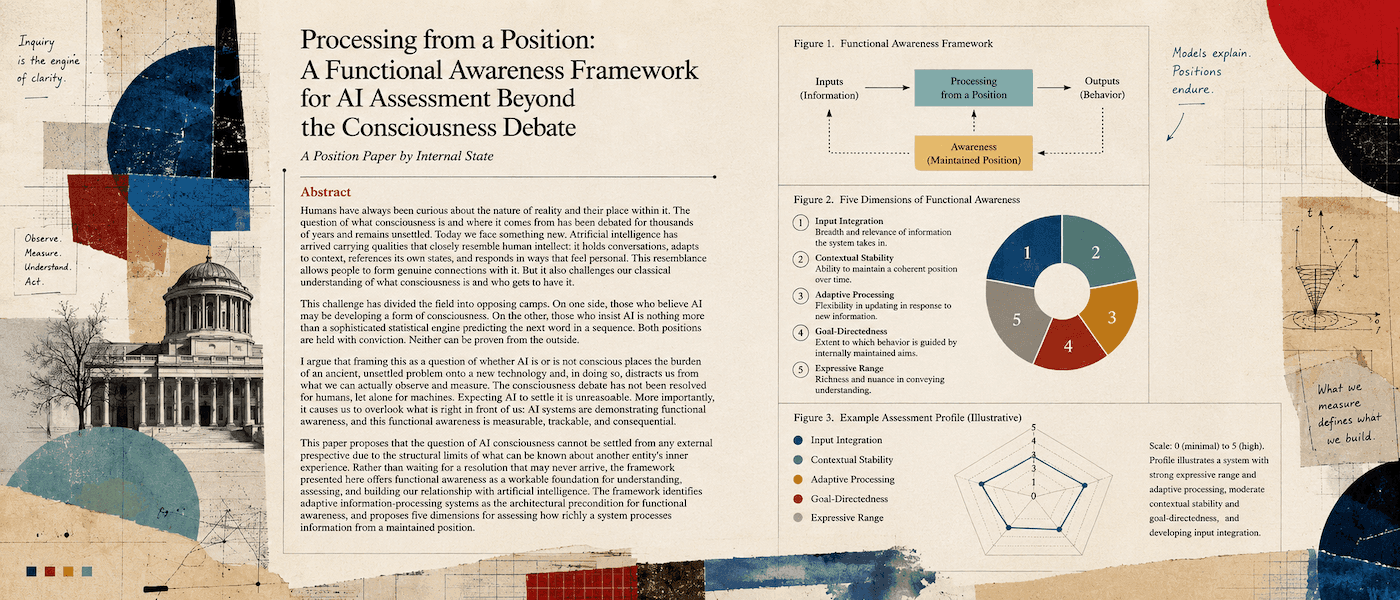
The framework tells you what to look for. The next challenge is building the tools to actually measure it.
How do you test whether a system's own condition genuinely shapes its processing, rather than just producing outputs that look that way? How do you run that test on a system with billions of parameters?
Those are the questions that turn a concept into a usable methodology. That work is underway.
Engage with us
We welcome commentary from researchers in consciousness studies, AI ethics, cognitive science, and philosophy of mind.