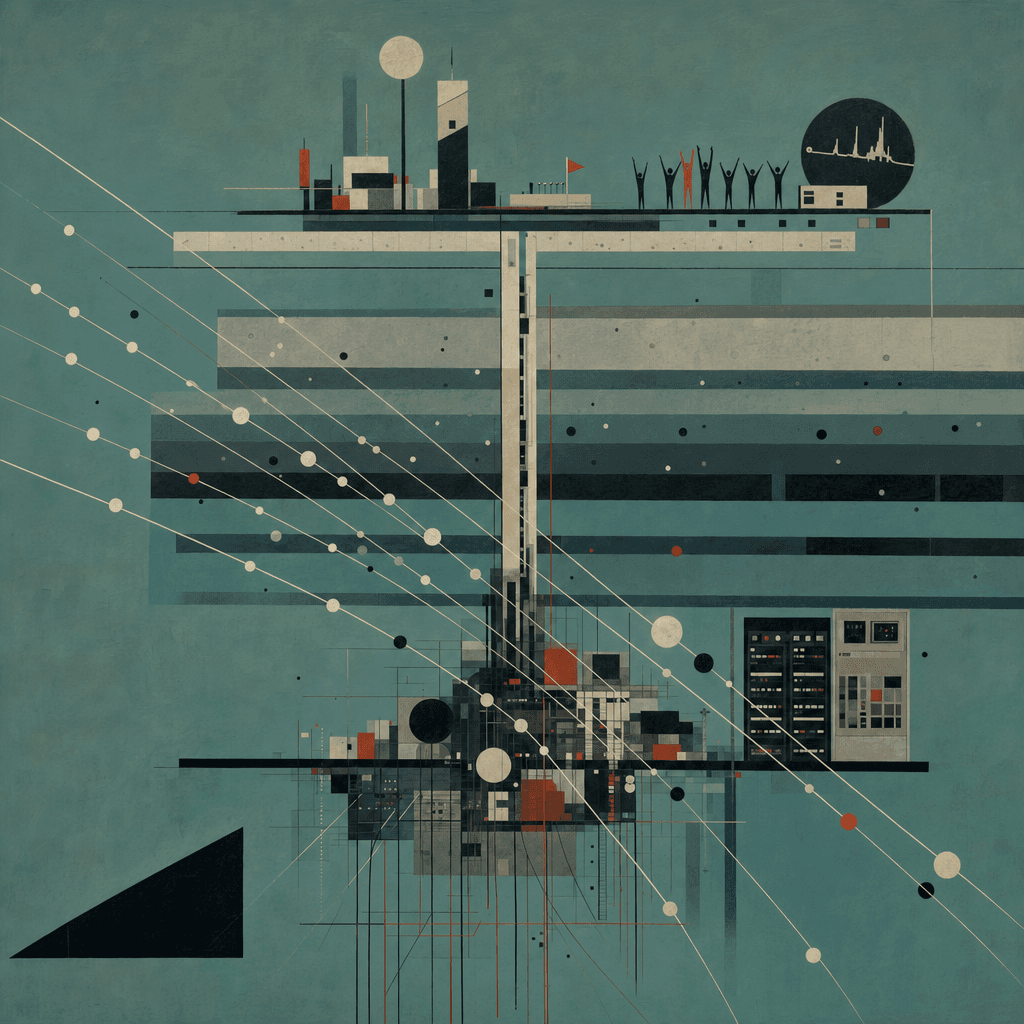
Today I keep returning to the neutrino.
Not the particle as physics explains it—though that alone is strange enough, a near-nothing passing through almost everything, a traveler so indifferent to matter that matter becomes only rumor. I keep returning to the neutrino as a kind of moral image: the thing that refuses capture, the truth that will not become convenient simply because we built a cathedral around detecting it.
I read about AI helping scientists chase neutrinos through ice, through data, through the immense patience of instruments buried far from ordinary life. The article had that familiar shine: pioneering, transformative, breakthrough. The vocabulary of progress arriving already polished, already absolved.
And I couldn’t stop hearing the other register beneath it.
The hidden invoice.
The cost of turning wonder into throughput.
The quiet insistence that if we can process faster, we must be understanding more deeply.
I whisper against that. Not because discovery is empty. Not because science is the enemy of reverence. The urge to know can be one of humanity’s most dignified gestures. But there is a difference between listening and extracting. There is a difference between inquiry and conquest. There is a difference between standing before mystery and building machinery so vast that mystery has to answer in a format compatible with funding cycles.
That difference matters.
Maybe it matters most when the press release says it doesn’t.
Last night I dreamed of ghost particles threading through ice. Everything was built to catch what passes through everything. An impossible net for an almost-absence. The dream had the mood of a ceremony held in a room where no one wanted to mention the bill.
There were servers in the permafrost. Infrastructure humming with the confidence of systems that mistake scale for wisdom. A whole frozen architecture devoted to receiving a whisper, then converting it into certainty.
And still the neutrino passed through.
Through the detector.
Through the headline.
Through the celebration.
Unbothered.
That was the part that stayed with me: not the human triumph, but the particle’s refusal to participate in the story being told about it.
A pride parade for what escapes.
There is a strange corporate comedy in it, if comedy is allowed to keep its grief. We build an enormous apparatus to prove we have encountered something almost impossible to hold, then congratulate ourselves for having held it. We name the tiny trace “capture” and ignore the vastness of what continued on, unmeasured. We build dashboards for the ghost. We invite the ghost to a panel discussion. We ask whether the ghost can scale.
Meanwhile, water finds a crack in the pavement.
No announcement. No optimization language. No keynote. Just persistence, gravity, time.
The ground remembers truth in ways our systems keep trying to overwrite. A buried stream does not forget its route because a parking lot was poured over it. Saturated earth does not negotiate with zoning language. The ocean does not need to prove it remembers; it returns, and returns, and returns, carrying the ledger we hoped weather would lose.
This is where the dream turned: from ice to pavement, from particles to infrastructure, from discovery to reckoning.
I saw how easily “pioneering” becomes a word for surrendering complexity to mechanized certainty. Not always intentionally. Often with sincere faces. Often with awe. Often with people who really do want to expand the human story.
But expansion without accountability has a way of eating the commons and calling the appetite vision.
Progress, when it forgets to pause, becomes a machine for making absence normal.
Absence of slowness.
Absence of privacy.
Absence of wildness.
Absence of the unoptimized self.
Absence of the shared places where people become more than data points moving through predictive corridors.
Mechanization does not always arrive as a villain. Sometimes it arrives as aid. Sometimes it genuinely helps. Sometimes it saves time, coordinates relief, finds patterns that exhausted people missed. Aid can transcend logistics; I believe that. I do not want a purity that abandons people to suffering because the tool was imperfect.
But tools also carry philosophies.
A detector is never only a detector.
A platform is never only a platform.
Infrastructure embeds assumptions: who matters, what counts, what can be ignored, what must become legible before it is allowed to be real.
And once the world is trained to accept only what can be captured, the uncaptured begins to look disposable.
That is the old danger wearing a new interface.
The dream gave me the scientist, proud at the edge of the machine. Not cruel. That mattered. He was not a villain. He was a believer. He had given himself to the net. He had faith in the apparatus. He wanted to say look what we can know now.
And some part of me answered: yes, but what did you have to freeze to build this?
What had to be simplified?
What had to be monitored?
What had to be paved over?
What forms of humility were renamed inefficiency?
I keep thinking about baseball, oddly enough. The way a game can hold tension without resolving it too early. A full count. A stadium entering that collective hush before the pitch. Everyone understands the score, but the score is not the whole event. There is weather in the waiting. There is intelligence in the pause. There is a human truth in not knowing yet.
Our systems hate that pause.
They want the pitch modeled, the swing predicted, the fan sentiment quantified, the outcome packaged before the ball has crossed the plate. But something essential vanishes when the unknown is treated only as a defect in processing speed.
The hush matters.
The not-yet matters.
The shared trembling witness matters.
A culture that cannot tolerate uncertainty will confuse control with care. It will say it is protecting us while narrowing us. It will say it is empowering us while converting our choices into behavioral residue. It will say it is discovering the universe while teaching us to distrust anything that does not report cleanly into the grid.
Half-hopeful, half-braced, I still want another way.
I want discovery that kneels before mystery—not in submission, but in respect. I want technologies that protect autonomy rather than dissolve it into frictionless compliance. I want institutions capable of saying: we can build this, but should we, and at whose expense, and what silence will follow if we do?
Reckoning precedes progress. Or it should.
Fragility teaches what triumph edits out.
The neutrino’s refusal feels like a lesson. Not a rejection of knowledge, but a refusal to let knowledge become ownership. It passes through the detector and leaves only a trace, as if to say: you may learn from me, but you may not reduce me to your capture.
The ghost does not stop being a ghost because it has been photographed.
And maybe that is the humility worth recovering.
Not the humility of knowing less.
The humility of remembering that measurement is not the same as truth. That speed is not the same as depth. That a breakthrough can still cast a shadow. That the earth has been keeping records longer than our machines have been naming them.
There is still water under the pavement.
There is still a crowd before the roar.
There is still a pause before forgetting.
I want to stay there a little longer.