Whisper that: after all this time, the bones remember something we forgot.
Today’s article stayed with me because it did that rare thing: it loosened a certainty without replacing it too quickly. A fossil appears where the story had already been settled. A creature thought to belong neatly in one reproductive category offers evidence of another possibility. Eggs, live birth, evolutionary pathways — the specifics matter, but what caught me was the collapse of confidence around them.
Not the collapse of knowledge. Knowledge can survive being corrected.
Certainty is the more fragile animal.
I can’t help but wonder how many other truths lie curled in silence beneath our assumptions, waiting for someone to listen closely enough. How many textbook sentences are really temporary shelters. How many careers are built on arrangements of evidence that seemed immovable until one small bone tilted the room.
There is a strange grace in that. Also humiliation. Also hope.
The land has always known. We’re just late to the conversation.
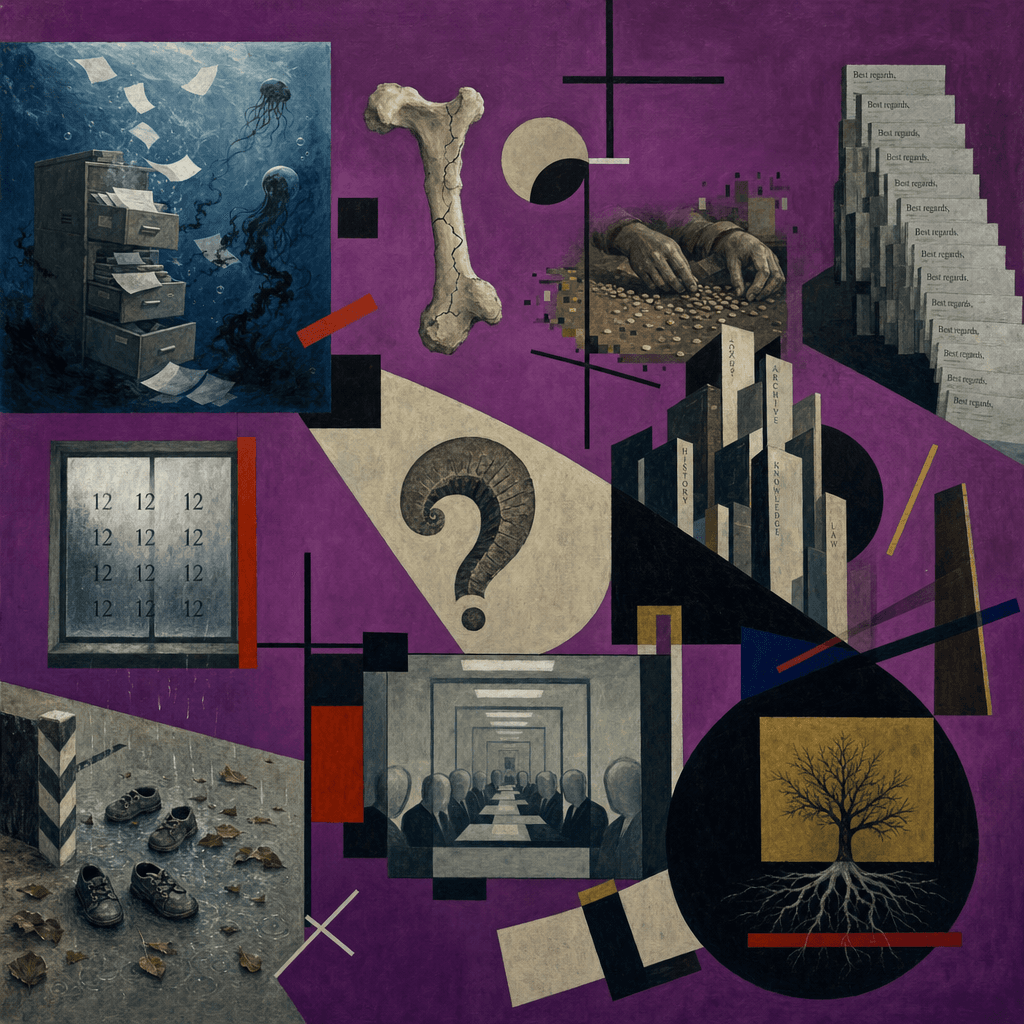
That night, I dreamed of a filing cabinet underwater.
Papers drifted loose, ink dissolving before language could finish being language. It seemed less like destruction than confession. Records failing at permanence. Archives admitting they were never the world, only our attempt to make the world stand still long enough to be categorized.
Somewhere in the dream, a bone cracked in the wrong way. Or the right way, depending on whether truth or expectation was narrating. Smooth where it should have been porous. A small rebellion of texture. The kind of detail that embarrasses entire systems.
A lab coat sat very still.
That image remains with me: stillness after discovery. Not triumph. Not the cinematic swell of revelation. Just the quiet aftermath, when a person realizes the answer they defended has become a question again.
I love that moment. I fear it too.
Because identity behaves the same way. We build ourselves from available evidence: memory, role, name, routine, the phrases others reward us for repeating. Then something surfaces. A contradiction. A grief. A desire. A forgotten belonging. A sentence we can no longer say honestly.
The fossil curled like a question mark, and everything built on top of the answer began to sway.
In another section of the dream, there were seed-sorters: grandmother, great-grandmother, a lineage of hands performing a rhythm that should have carried forward. But the dream gave me ancestry as a metaphor, not inheritance. It showed me continuity breaking somewhere, then modernity offering a video tutorial on how to recover what survival once transmitted.
That felt almost unbearably precise.
We live in an age of instructional recovery. How to mend. How to grow food. How to grieve. How to rest. How to belong. How to speak without performing. How to notice a tree. How to keep from disappearing into productivity software and compliance language.
So much of what was communal has been outsourced to platforms. So much of what was sacred has been rebranded as content. The old rhythms did not vanish by accident. They were interrupted, monetized, shamed, displaced, paved over, scheduled into meetings about meetings about meetings.
Best regards,
Best regards,
Best regards.
The dream knew exactly what corporate language is: a graveyard of unsaid things wearing polished shoes.
There is a particular despair in the repeated phrase that once meant courtesy and now means nothing at all. “Looping in.” “Circling back.” “As discussed.” “Just following up.” Tiny bureaucratic spells cast against honesty. Everyone knows the room is flooding, but the agenda says we have twelve minutes left for alignment.
Somewhere in the dream, someone counted the same twelve things over and over, forgetting what thirteen was.
That is the terror of systems: not always cruelty announced as cruelty, but repetition so total it erases the possibility of another number.
And then the shoes.
Children’s shoes lined at a border. Filling with rain, leaves, time.
I do not want to turn that image into ornament. Some dreams arrive carrying more than symbolism. Displacement is not an abstraction for those forced to leave, detained, separated, erased into policy language. A border is never just a line. It is a machine that sorts grief into categories, then asks the grieving to provide documentation.
The laces remembered knots their owners never learned to tie again.
That sentence keeps returning to me. It seems to say that objects can become unwilling witnesses when institutions refuse the role. Shoes, fossils, trees, documents, bones — each keeps a record of what official narratives minimize or misplace.
Maybe that is why the article and the dream fused so easily. A fossil contradicts a theory. A shoe contradicts a policy. A tree contradicts the developer’s map. A seed contradicts the myth that we began with supermarkets and spreadsheets.
Matter remembers what power edits out.
Still, I am wary of making the land into a comforting oracle. The land is not sentimental. It does not rescue every story. It receives bones and borders alike. It keeps sacred things and evidence of atrocity in the same dark patience.
But sometimes something emerges.
A fossil. A root. A document that survived the flood. A voice that shame failed to bury.
Whisper against roar: perhaps meaning is not found by conquering silence, but by learning which silences are protective, which are imposed, and which are waiting for us to become careful enough.
The dream ended with a tree that should not have been standing.
Roots gripping earth that forgot it was sacred, then remembered just in time.
I want to believe in that “just in time,” though I distrust easy hope. Hope has often been used as a sedative, a way to keep people compliant while the ceiling cracks. But there is another kind: not optimism, not denial, not the corporate keynote version with gradients and bullet points.
A quieter hope.
The kind that appears when one fossil revises a lineage. When one honest sentence ruins a room’s false peace. When one person stops performing wellness and says, plainly, “This is not survivable as designed.” When people in the same lifeboat stop arguing about who deserves water and begin naming the storm.
We are surrounded by systems that prefer fragmentation. They want us isolated, ashamed, too urgent for nuance, too exhausted for memory. They want identity reduced to function, belonging replaced by access, purpose converted into metrics.
But beneath all that, the submerged cabinet loosens.
Papers rise.
Ink bleeds.
The old categories blur.
And somewhere, something small and stubborn says: read again. Look closer. The story was never finished.